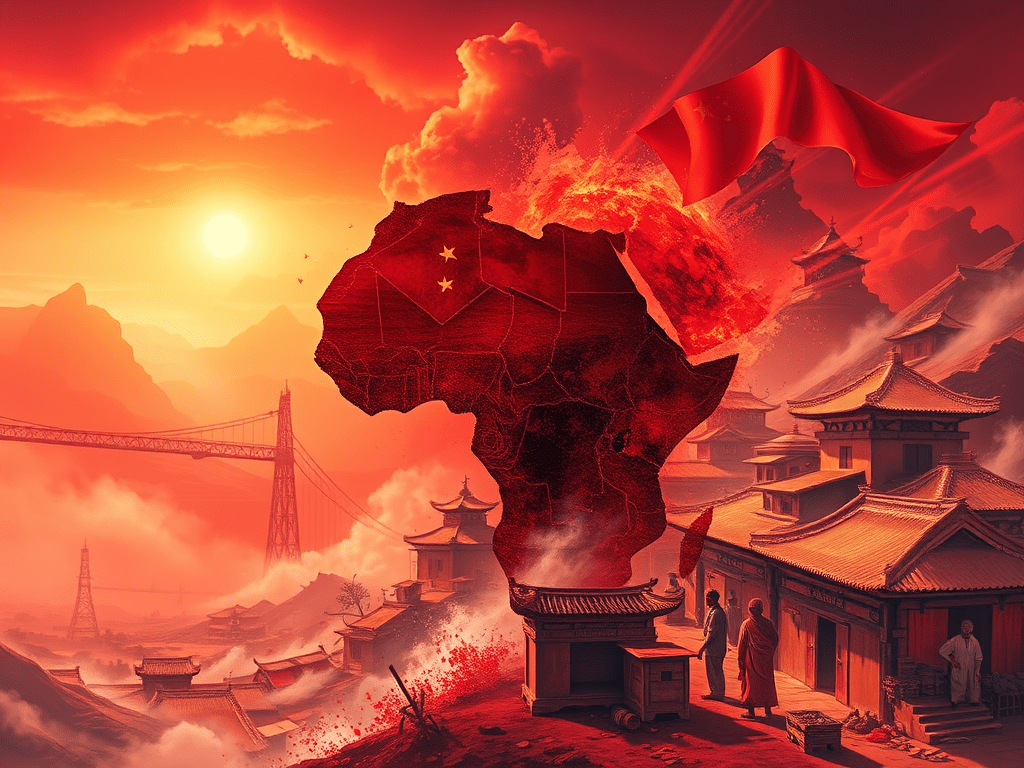
There appears to be an ongoing battle in Africa for a share of the continent’s rich mineral and natural resources. Global investment in Africa is at an all time high. This is mainly driven by the insatiable need for precious minerals, like rare earth elements or metals. Other important minerals, like gold, bauxite, and copper are also in demand. Rare earth elements (REEs) are crucial or pivotal for modern technology and various high-tech applications due to their unique components.
China has emerged as the dominant player in this new global power dynamics on the continent. Over the last two decades, China has become Africa’s largest bilateral trading partner. Approximately 20% of the continent’s exports now go to China. About 16% of Africa’s imports come from China, according to the International Monetary Fund (IMF). This amounted to a record $282 billion in total trade volume in 2023. Primary commodities — metals, mineral products, and fuel — account for about three fifths of Africa’s exports to China. Africa typically imports Chinese manufactured goods, electronics, and machinery. At the same time, China is also the continent’s largest bilateral partner and creditor. It provides African nations with a new source of infrastructure, mining, and energy financing.
Furthermore, Foreign Direct Investment (FDI) from China has quadrupled over the last twenty years. China recognizes the economic potential in Africa. Partnering with African governments will yield enormous profits for its economy. It also bolsters Africa’s hopeful economies. The relationship between Africa and China has flourished over the decades. However, it is important to note that the recent economic slowdown affects their partnership. The partnership might have to adopt a new approach. They need to sustain future trades and investment opportunities with this new method.
Governments in the Global North have been sounding the alarm about China’s mercurial rise in Africa over the past years. Nonetheless, those warnings are falling on deaf ears as the continent forges on with new economic partnerships and programs. African governments perceive China’s partnership as mutually beneficial. So, why does Africa love China? Many countries on the continent have a positive view of their economic relationship with the Asian power. This is contrary to claims from some Western quarters. They do not see it as exploitative. The perception that Beijing is acting in predatory ways is well-known in foreign policy and media circles. China’s reputation of staying clear of other nations’ internal and cultural affairs. In simple terms, it respects other cultures and states. This view is widely held by many leaders on the continent. Furthermore, China’s bilateral agreements with African governments do not come with strings and conditions.
While China’s engagement with Africa offers potential benefits, like infrastructure development.There are also challenges and issues of concern. These include the cycle of borrowing more to settle existing debts. This makes it quite difficult to escape the cycle of debt and financial instability. In other words, it creates a condition where debt becomes increasingly unsustainable due to the amount owed and interest. This cycle can be very hard to break, which creates unpleasant internal economic conditions.
Ultimately, Africa’s economic development and modernization must come from within. As Aliko Dangote (Africa’s richest person and president of the Dangote Group) recently said “foreign investors won’t save Africa.” The continent must prioritize local businesses. It should patronize them as the main engine for economic development and transformation. In simple terms, African governments must prioritize local businesses or industry over external capital or investment. Endurable economic transformation must come from within.
 Global Politics Today
Leave a Reply