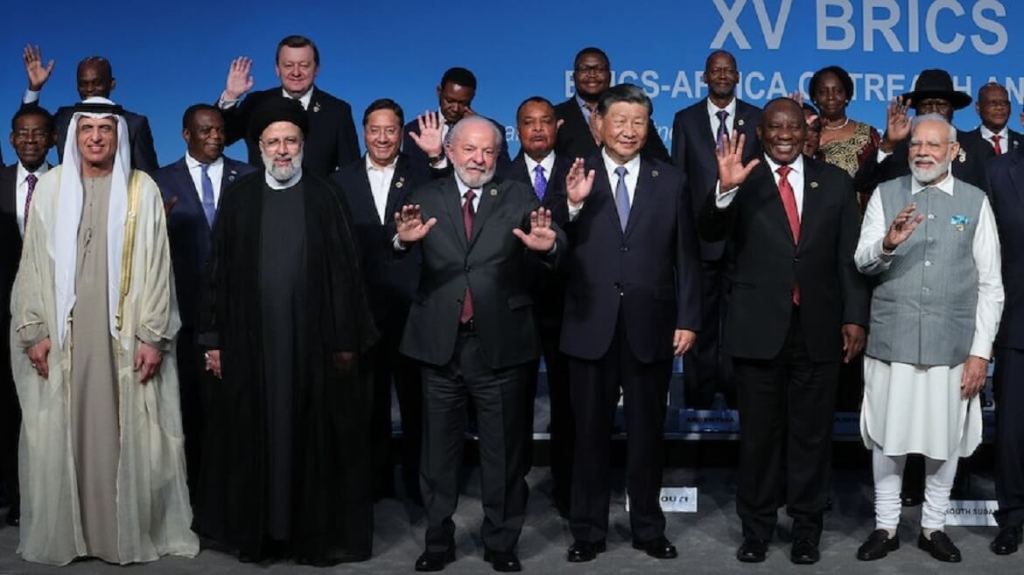
In 2001, an economist from Goldman Sachs (Jim O’neill) coined the term BRIC to describe the fast-growing markets of Brazil, Russia, India, and China. In 2006, the foreign ministers from the four countries met informally for the first time on the sidelines of the United Nations General Assembly in New York. In 2009, the bloc held its inaugural official summit in Russia, turning the financial idea into a geopolitical alliance. The alliance was joined by South Africa in 2010 thereby changing the acronym to BRICS at the 2011 summit.
In recent years, the alliance has welcomed several countries in the Global South ( Egypt, Ethiopia, Indonesia, Iran, Saudi Arabia, and the United Arab Emirates), thereby changing the acronym again to BRICS+. The BRICS+ account for more than 40% of the world’s population and 40% of the world’s GDP. They also account for about 26% of global trade. Put together, the alliance is a major force in global geopolitics. They seek to transform the postwar liberal International Order, which is largely perceived as ineffective and outdated. In other words, the status quo does not reflect or represent the realities of the 21st century. Global power dynamics must be overhauled or restructured to suit a new multipolar reality, thereby ensuring a more equitable distribution of representation within supranational decision-making bodies.
The BRICS+ have a major concern with hierarchical power relations and unfair conditionalities imposed by Western-led institutions, which they argue constrain national sovereignty and perpetuate or preserve economic dependence. in light of this and others, the alliance has come up with mechanisms such as the New Development Bank and the Contingent Reserve Arrangement. Established in 2014, the Contingent Reserve Arrangement is a joint economic partnership between the BRICS+ to provide mutual liquidity support during short-term currency pressures.
Political, security, and economic cooperation are some of the major pillars underpinning the BRICS+ alliance. The economic and security initiative or cooperation primarily focuses on reforming or overhauling multilateral institutions such as the United Nations and its Security Council to make them more representative. Multilateralism should promote a fair, multipolar world anchored on mutual respect and sovereign equality.
The BRICS+ believe that global governance does not reflect the new reality of the modern world. In other words, the places or arenas where consequential global decisions are made do not represent the will of many countries around the world. Sceptics from the start have raised concerns over whether the alliance could become a viable or functional global force. However, over the past several years, the BRICS+ countries have been drawn closer economically.
Trading in goods and services among BRICS+ countries has outpaced that between BRICS+ and G7 countries in the past five years, leading to greater intra-BRICS+trade intensity. Furthermore, rapid economic growth has given the BRICS+ countries far more clout and weight in the global economy.
The BRICS+ countries are eager to develop greater independence from Western-dominated financial and supranational institutions. About 90% of global foreign exchange transactions are conducted in US currency and flow directly through American and European banks. Since the BRICS+ countries include leading commodity exporters and importers, the alliance can become an avenue for foreign exchange transactions other than US currency.
Recent developments and geopolitical tensions, economic ambitions, political uncertainties, and a global pandemic have clearly revealed structural challenges and deficits in the international system. The growth of the BRICS+ shows that emerging markets are ready to insert their influence and take a larger role in the world order.


Leave a Reply